
Waiting on God When the Silence Feels Long
Waiting on God is rarely glamorous.
It often feels quiet.
Unnoticed.
Slow.
We tend to celebrate moments of arrival. Breakthroughs. Answers. Clarity. Yet Scripture often places just as much weight on what happens before those moments arrive. Luke offers a quiet story that unfolds in the background of a much larger narrative. It is a story where promise and patience overlap. Where long obedience finally meets fulfillment.
Luke 2 is not only about arrival.
It is about waiting on God over the long haul.
And for many people, waiting on God is one of the hardest spiritual disciplines to sustain.
You wait for direction.
You wait for healing.
You wait for God to act on something He placed in your heart long ago.
Over time, waiting can stretch faith thin.
Why Waiting on God Feels So Hard
Waiting exposes what we do with uncertainty. It presses on trust. It confronts our desire for control. When answers do not come quickly, even sincere faith can begin to feel fragile.
Long seasons of waiting often lead to quiet questions.
Is God still attentive?
Did I misunderstand His promise?
Is anything actually happening?
Scripture does not avoid these tensions. Instead, it gives us real people who lived inside them. One of those people is Simeon.
Simeon Lived in a Spiritually Dry Season
Simeon lived during a season that felt barren on every level.
Politically, Israel had lost its independence. Rome ruled with force. Local leadership was compromised. God’s people lived under pressure with little hope of change.
Spiritually, things felt just as bleak.
The temple still stood, but the felt presence of God was gone. The glory that once defined Israel’s worship had departed generations earlier. Religious leadership had grown hollow. Legalism weighed people down. Many had stopped expecting God to intervene at all.
God had also been silent.
For centuries there had been no prophet. No fresh word. No clear direction. Generations lived and died holding promises they never saw fulfilled.
This was the environment in which Simeon learned how to wait on God.
A Quietly Faithful Life
Luke describes Simeon with simple but weighty language.
He was righteous and devout.
That mattered. In a compromised spiritual culture, Simeon remained grounded. He was not a priest. He held no position of authority. He was not influential.
He was faithful.
Luke also tells us the Holy Spirit rested on him. That detail is important. In earlier Scripture, this language was often associated with prophets or kings. Simeon was neither.
He was an ordinary man who kept showing up.
And Simeon was waiting.
Luke says he was waiting for the consolation of Israel. In other words, he was waiting for comfort, restoration, and redemption. He was waiting for God to return to His people and make things right.
Where many had grown cynical, Simeon stayed expectant.
The Risk of Waiting on a Promise
Simeon carried a personal promise. The Spirit had revealed that he would not die before seeing the Messiah.
That promise was gracious.
It was also vulnerable.
God had been silent for generations. Claims like that likely sounded unrealistic to others. Some may have dismissed Simeon. Others may have quietly hoped he was right.
Simeon waited anyway.
Waiting on God often requires trusting Him without social reinforcement. Faithfulness is rarely applauded in seasons of delay.
Led at the Right Time
One ordinary day, the Spirit prompted Simeon to go to the temple.
At the same time, a young couple arrived with their infant son to dedicate Him according to the law. There was no announcement. No spectacle. Just quiet obedience.
And there, in the overlap of faithfulness and timing, everything changed.
Simeon saw the child. The Spirit made it clear. This was the One.
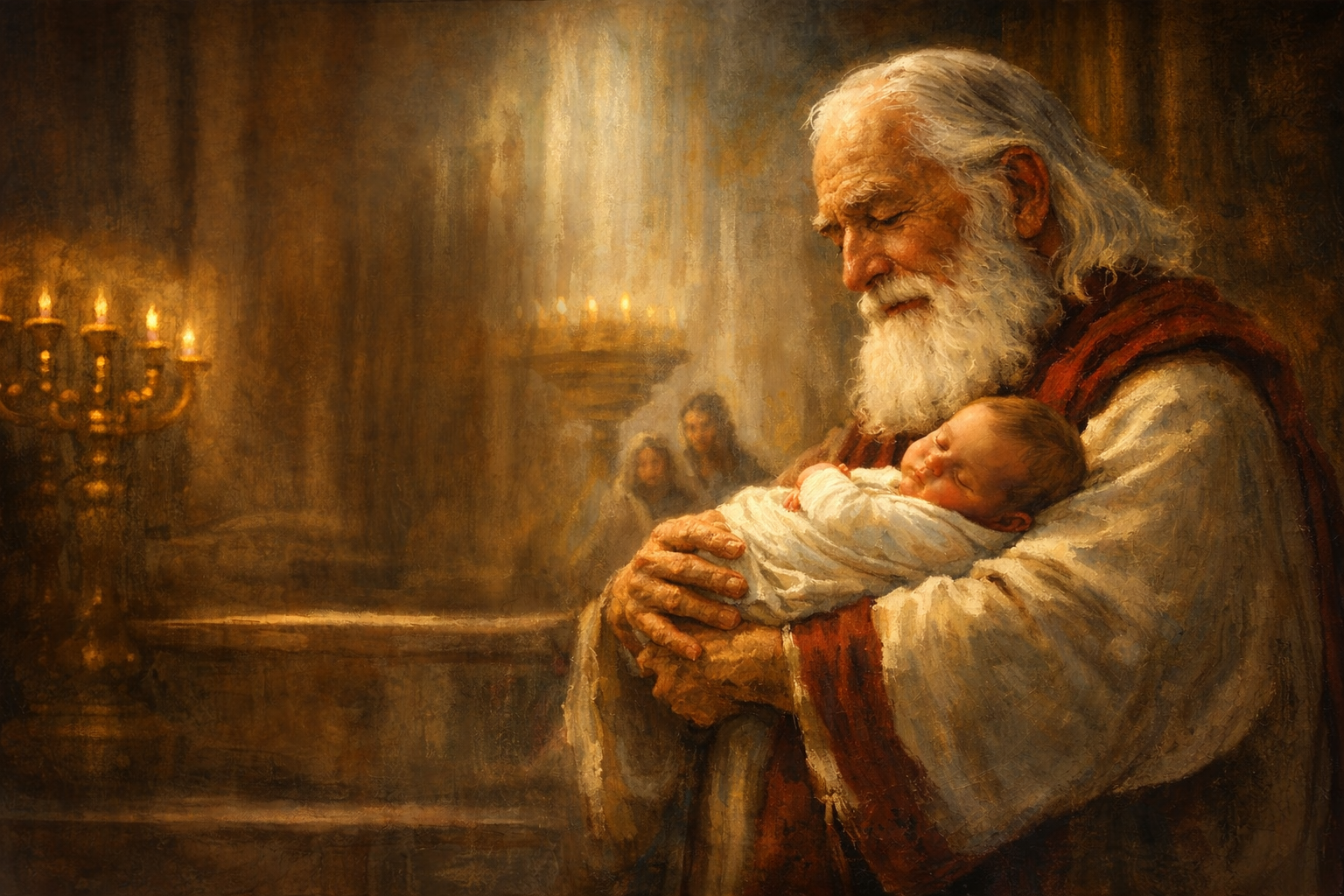
Luke tells us Simeon took the child into his arms.
Everything he had trusted God for.
Everything he had carried in hope.
Everything generations had waited to see.
Now rested in his hands.
When Faith Finally Becomes Sight
Simeon responded with worship.
“My eyes have seen your salvation.”
God had kept His word.
Simeon also recognized that this salvation extended beyond Israel. It would be light for the nations. God’s heart had always been larger than borders. Darkness would not have the final word.
Then Simeon spoke of glory.
For centuries, the glory of God had been absent from the temple. Now it had returned. Not as fire. Not as a cloud. But as a human life.
God had come back to His people in an unexpected form.
After centuries of waiting, God proved faithful.
What Simeon Teaches Us About Waiting on God
Simeon’s story offers a steady reminder for seasons of uncertainty.
God can be trusted, even when the wait feels long.
Waiting does not mean God is absent. Silence does not mean God is inactive. Delay does not mean denial.
Simeon stayed righteous.
He stayed attentive.
He stayed responsive to the Spirit.
He kept showing up, even when the space felt empty.
Waiting did not harden him.
Waiting refined him.
And in time, his faith became sight.
A Word for the Season You Are In
You may be waiting on God right now.
Waiting for clarity.
Waiting for healing.
Waiting for direction.
Waiting for something God promised that has not yet arrived.
Simeon’s story reminds us that God is faithful to His word. Those who place their hope in Him will not be put to shame.
Sometimes the deepest work God does in us happens while we wait.
